Project director:
Teddy Craciunescu (INFLPR)
email:teddy.craciunescu@inflpr.ro
National Institute for Lasers, Plasma and Radiation Physics INFLPR Magurele, Romania
Team:
Teddy Craciunescu, Calin Vlad Atanasiu, Daniela Nendrean
External Partners:
- Consorzio RFX (CNR, ENEA, INFN, Universita’ di Padova, Acciaierie Venete SpA), Padova,
Italia
- Universitaty of Rome Tor Vergata, Italiy
- CIEMAT, Madrid, Spain
WPAC contributes to the implementation of the European Roadmap, in which theory and simulation play a strong role, it is crucial to further bring together the accumulated knowledge and expertise in these fields under a highly focused Theory, Simulation, Verification and Validation (TSVV) programme. The development in these areas are key enablers that must be retained within the programme to advance our understanding and predictive capabilities. They will underpin the production of a high- quality suite of “EUROfusion standard” software (building on the research software) to model data from EUROfusion facilities and to reliably extrapolate to future devices.
Project objectives:
Numerical Simulations of Disruption Current Spike generated by the Wall Touching Kink Mode
Disruptions represent an unacceptable instability in the next step tokamaks. They can cause substantial damage to the in-vessel component of the machines, which are in contact with the plasma. The Wall Touching Kink Mode (WTKM) – a nonlinear MHD instability – leads to a dramatic quench of the plasma current within ms: very energetic electrons are created (runaway electrons) and finally a global loss of confinement happens, i.e. a major disruption. The WTKM are frequently excited during the Vertical Displacement Event (VDE) and cause big sideways forces on the vacuum vessel. Deep understanding of the disruption phenomenon became now the highest priority topic in tokamak plasma physics. Understanding that in disruptions the sharing of electric current between the plasma and the wall plays an important role in plasma dynamics, we have developed a wall model that covers both eddy currents, excited inductively, and source/sink currents due to current sharing between the plasma and the wall [5 – 7]. The tokamak disruption simulations require a realistic model of the conducting structures around the plasma, referred here for simplicity as a “wall”. A proper representation of its 3D structure (ribs, limiters, penetrations, gaps) is absolutely essential. In our numerical codes for source- sink-eddy currents calculation [5] we have included rib-like wall elements and have determined the matching conditions at joint of a rib-like wall element with the toroidal wall surface. The variational principle for source-sink-eddy currents in a thin wall with a rib-like wall element has been deduced [8]. Although it is the best prototype for ITER, the JET tokamak has a distinct element, namely the iron core which can affect the stability of the plasma. As a consequence of the high non-linear dependence of the magneto-hydrodynamic solutions on the iron permeability µFe in JET, we have taken into account the influence of ferromagnetic components in the equations of the surface currents developed in the vessel structures during WTKMs by reviewing the equations to be solved in order to simulate the influence of the ferromagnetic components in VDEs and equilibrium stability calculations [9]. Finally, via this project we intend to create the first numerical model implementing the physics of the WTKM as the driver of tokamak disruptions.
References
- L.E. Zakharov, Phys. of Plasmas 15, (2008).
- P. Noll et al, Present Understanding of Electromagnetic Behavior during Disruptions in JET, Proceedings of the 19th Symposium on Fusion Technology, Lisbon, Portugal, 16–20 September 1996.
- L. E. Zakharov, H. Xiong, D. Hu, X. Li, C. V. Atanasiu, Theory and Simulation of Disruptions Workshop, July 17-19, PPPL, Princeton NJ (2013).
- E.P. Gorbunov E.P. and K.A. Pazumova K.A., At. Energy 15 363 (1963).
- L. E. Zakharov, C. V. Atanasiu, K. Lackner, M. Hoelzl, and E. Strumberger, J. Plasma Phys. 81, 515810610 (2015).
- C. V. Atanasiu, L. E. Zakharov, K. Lackner and M. Hoelzl, J. Phys. Conf. Series 1141 1212065 (2018).
- C.V. Atanasiu, L.E. Zakharov, K. Lackner, M. Hoelzl and E. Strumberger 2017, Simulation of the electromagnetic wall response to plasma wall-touching kink and vertical modes with application to ITER, 59th Annual Meeting of the APS Division of Plasma Physics, Milwaukee, WI, US, October 23-27, 2017 (oral).
- C.V. Atanasiu, L.E. Zakharov, M. Hoelzl, Tokamaks Vertical Displacement Events and disruptions simulations for realistic 3D non-symmetrical wall geometries, International Conference on Plasma Physics and Applications – CPPA2023, Iasi, Romania, 14 to 16 June (2023) (oral) (sent to Phys. Plasmas – not accepted yet).
- C.V. Atanasiu, L.E. Zakharov, M. Hoelzl, S.N. Gerasimov, J. Phys. Conf. Series 1730 012115 (2021).
- F.J. Artola, C. Atanasiu, M. Hoelzl, G.T.A. Huijsmans, K. Lackner, S. Mochalskyy, G. Oosterwegel, E. Strumberger,
- L. Zakharov, “Second intermediate report for ITER project IO/16/CT/4300001383” on the “Implementation and validation of a model for halo-currents in the nonlinear MHD code JOREK and demonstration of 3-D VDEs simulations in ITER”, Version 2, March 5th 2018.
- C.V. Atanasiu, L.E. Zakharov, X. Li, J. Phys. 1391 012123 (2019).
Potential leading edge effect in in plasma energy deposition to material surfaces during disruptions triggered by Vertical Displacement Events (VDE) in tokamak
The understanding of plasma disruptions in tokamaks and predictions of their effects require realistic simulations of electric currents excited in 3D vessel structures during the Vertical Displacement Events (VDE) and by the plasma Wall Touching Kink Modes (WTKM) instabilities. These instabilities cause big sideways forces on the vacuum vessel which are difficult to confront in large tokamaks like ITER or DEMO. Understanding that in disruptions the sharing of electric current between the plasma and the wall plays an important role in plasma dynamics, we have developed a wall model that covers both eddy currents, excited inductively, and so source/sink currents due to current sharing between the plasma and the wall [1-3]. Considering for MHD simulations the TMHD (Tokamak MHD) model [4] we have to consider adaptive grids which are aligned with the 3-D ergodic magnetic field lines, so- called Reference Magnetic Coordinates (RMC) [5]. Due to the fact that during fast VDE disruptions, the plasma acquires a contact with the plasma facing material surfaces (e.g., protective plates in ITER), the instability generates the edge Hiro currents [6] which from the free plasma surface enter the “wall” surface mostly through the contour of the wetting zone. This creates the scenario when the leading edge effect with concentrated power deposition at the edges of the plates and potential destruction of the edges. This effect could be considered by as an important cause of wall melting in JET and as a cause the formation of runaway electrons.
References
- L. E. Zakharov, C. V. Atanasiu, K. Lackner, M. Hoelzl, and E. Strumberger, J. Plasma Phys. 81, 515810610 (2015).
- C. V. Atanasiu, L. E. Zakharov, K. Lackner and M. Hoelzl, J. Phys. Conf. Series 1141 1212065 (2018).
- F.J. Artola, C. Atanasiu, M. Hoelzl, G.T.A. Huijsmans, K. Lackner, S. Mochalskyy, G. Oosterwegel, E. Strumberger,
- L. Zakharov, “Second intermediate report for ITER project IO/16/CT/4300001383” on the “Implementation and validation of a model for halo-currents in the nonlinear MHD code JOREK and demonstration of 3-D VDEs simulations in ITER”, Version 2, March 5th 2018.
- L. E. Zakharov, X. Li, Phys. Plasma 22, 062511 (2015).
- L. E. Zakharov, S. A. Galkin, S. N. Gerasimov, and JET-EFDA contributors, Phys. Plasmas 19, 055703 (2012).
- L. E. Zakharov, H. Xiong, D. Hu, X. Li, C. V. Atanasiu, Theory and Simulation of Disruptions Workshop, July 17-19, PPPL, Princeton NJ (2013).
- C.V. Atanasiu, L.E. Zakharov, M. Hoelzl, S. Gerasimov, J. Phys. Conf. Series 1730 012115 (2021).
Bayesian ensemble algorithms for the decomposition of times series generated by tokamak diagnostics
Modelling of certain diagnostic signals as a combination of quasi-periodic elements of the time series, trends and change-points would be useful for the subsequent analysis of various phenomena like macroscopic charge-and-fire instabilities such as ELMs or sawteeth, slow drifts of the discharge properties and performances due to impurity accumulation or current diffusion. This project aims to use a Bayesian ensemble approach to model the decomposition of time series which quantifies the relative usefulness of individual possible decomposition models, leveraging all the models via Bayesian model averaging. This approach has in principle the advantage to alleviate model misspecification, address algorithmic uncertainty, and reduce over-fitting. A promising development is to further use the developed methodology to train advanced machine learning tools for online application.
Results:
2024-2025
- The WTKMs are frequently excited during the VDEs and lead to big sideways forces on the vacuum vessel which are difficult to confront in large tokamaks. As the key basis for our plasma disruption modelling, we have considered the understanding of how currents flow to the plasma facing surfaces during plasma disruptions. We realized that the galvanic plasma-wall contact is critical in disruptions, and that the reproduction of 3D structure of the wall is important. Thus, we have developed a wall model that covers both eddy currents, excited inductively, and source/sink currents due to current sharing between the plasma and the wall. To obtain the space and time distribution of the surface currents, we have developed a weak formulation form (variational formulation) and have minimized the correspondent energy functionals in a Finite Element approach. We realized that the major player in plasma-wall interactions are the currents flowing between the plasma and the wall. As an example of currents sharing between plasma and the wall in VDE we have considered: (a) surface currents as the currents at the plasma boundary generated by free boundary MHD instabilities; (b) eddy currents in the wall, excited by perturbed magnetic field, which is screened by the plasma surface currents: (c) Hiro currents as the negative component of the surface currents shared between plasma and the wall (opposite to the plasma current 𝐼𝑝𝑙); (d) Evans current as the positive component of the surface currents potentially shared between plasma and the wall (same direction as 𝐼𝑝𝑙); (e) halo currents as the positive diffused currents to the tile surface from outside the last closed magnetic surface. In conclusion: We developed a Wall-Touching-Kink-Mode model for explanation of the negative voltage spike in tokamak disruptions. We mention that the financial support for this project was 1.0 PM and the research work presented here has been developed together with our colleague L.E. Zakharov from LiWFusion, Princeton, NJ 08543, USA, without financial support for him.
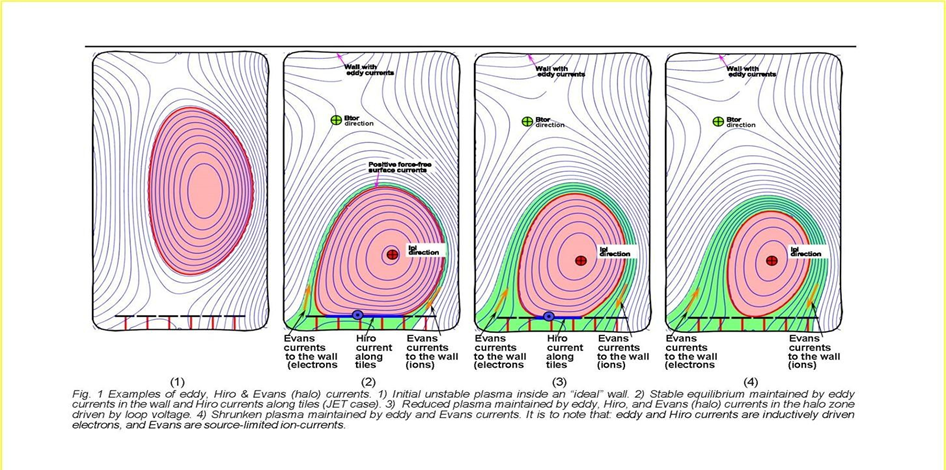
- Starting from the fact that on JET disruptions were capable of melting the plasma facing beryllium tiles, and similar wall damage in ITER should be assessed, in this project we had to consider two important disruption effects in both mitigated and non-mitigated disruptions in JET and ITER: (a) excitation of vertical disruption during the current quench (i.e., abnormal plasma current ramp down) and (b) potential leading edge effect in power deposition to the in- vessel tiles during disruptions related to the wetting zone of plasma and plasma facing surfaces. For this we had to determine: – the geometry of the wetting zone as well as the power deposition to edges of the protective plates in ITER and – the limitations on current decay rate given the geometry of vessel structure and characteristics of feedback stabilization systems. For this task, due to the fact that a conventional MHD model cannot solve numerical problems related to extreme plasma anisotropy and negligible mass we had to use the new mathematical model, called Tokamak MHD (TMHD) formulated for disruptions simulation as a replacement of conventional MHD . We had to upgrade the existing 2D VDE code the wall geometries of JET and ITER in order to perform simulation of VDE and to develop a 3D extended version of the simulation code of VDE.
- The vast majority of signals generated by tokamak diagnostics are in the form of time series. Consequently dealing with time-indexed data is a major task, to be tackled daily by both experimentalists and analysts. Decomposing a time series in terms of seasonal components, trends, change-points and noise is therefore a crucial activity, per se and as a preliminary step to further investigations. In the present work, the Bayesian ensemble approach to model decomposition of time series, originally developed for remote sensing of the earth, is applied to various global measurements routinely available in tokamak devices. Among the competitive advantages of the methodology, particularly relevant are its holistic view of the data and the independence from the details of the statistical algorithms and models. The potential of the technique, implemented by the BEAST code, has been assessed with both synthetic signals and experimental data. The approach proves to be very reliable in modelling trends and determining the time locations of abrupt changes even of strongly oscillatory components, such as ELMs and sawteeth. Deployment to assess small drifts confirms the lack of stationarity in tokamak high performance discharges. The difficulties of modelling the details of the sawteeth and irregular ELMs indicate the need to improve the method to deal with seasonal components of complex harmonic content and/or varying frequency. However, the available routines are already very effective in determining the times changes in the ELM regimes and could be refined for real time deployment.
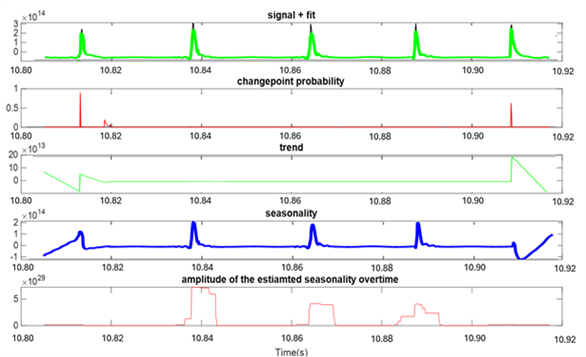
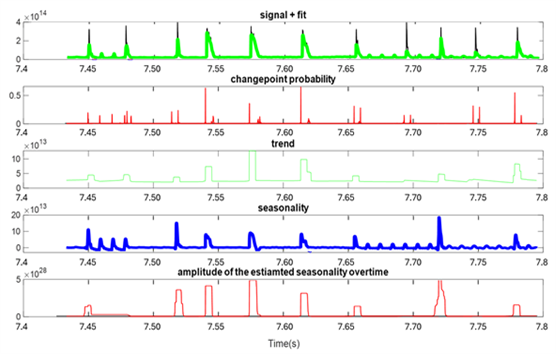
The seasonality component for JET discharge #94871, in which the oscillations of the ELMs are almost exactly periodic for several quite long time intervals. However the ELM frequency and behaviour vary quite abruptly depending on the phase of the pulse. The BEAST algorithm manages to identify the time location of these abrupt changes quite accurately. A different choice of the threshold would allow detecting also smaller variations in the ELM regimes at about 7s and 11.3 s.
Publications:
Papers
- Gelfusa, M., Craciunescu, T., Rossi, R., Murari, A., On the potential and limitations of Bayesian ensemble algorithms for the decomposition of time series generated by tokamak diagnostics (2025) Fusion Engineering and Design, 220, art. no. 115318 DOI: 10.1016/j.fusengdes.2025.115318
- Min Xu, Didier Mazon, Matteo Barbarino, Wolfgang Biel, R M Churchill, Rainer Fischer, Keisuke Fujii, Palak Jain, Andrea Murari, Simon D Pinches, Pablo Rodriguez-Fernandez, Joshua A Stillerman, Jesus Vega, Geert Verdoolaege, Masayuki Yokoyama, Paulo Abreu, Sajidah Akhter Bint Ahmed, Jerome Alhage, Feda ALMUHISEN, Michael George Bergmann, Diego Pereira Botelho, Leonardo Caputo, Stefano Carli, Rodrigo Castro, Teddy Craciunescu, Farah Deeba, Francisco Esquembre, Giil Kwon, Yu Gu, Joseph Hall, Jonathan Hollocombe, Xianli Huang, Axel Jardin, Rogerio Cabete de Jesus Jorge, Yang Li, Y Liu, Simon Mcintosh, Emmanuele Peluso, Riccardo Rossi, Mariano Ruiz, Jeffrey De Rycke, Mireille Schneider, Marco Sertoli, Aleix Puig Sitjes, Dirk Stieglitz, Yi Tan, Henri Weisen, Hao Wu, Ivan Wyss and Linge Zang, Summary of the 5th IAEA Technical Meeting on Fusion Data Processing, Validation and Analysis (FDPVA), Nuclear Fusion, accepted DOI 10.1088/1741-4326/ae048d
Conferences
- Sergei N. Gerasimov, Leonid E. Zakharov, Calin V. Atanasiu, “Toroidal asymmetry in current spike in JET disruptions”, International conference: “Contributions to Joint Runaway Electron Modelling (REM) and WPTE (Work Package Tokamak Exploitation) RT03 Analysis meeting 2-6 June 2025, EPFL Lausanne, Switzerland”.
- R. Rossi M. Gelfusa, T. Craciunescu, J. Vega, A. Murari, Avoiding the Collapse of the Tokamak Configuration: an AI based Control Strategy for Reactor Grade Devices, International Conference on Diagnostics For Fusion Reactors: the Burning Plasma Era (ICFRD2025), 1–5 Sept 2025 Varenna, Villa Monastero
Participarea Romaniei la EUROfusion WPAC si cercetari complementare
Director de Proiect
Teddy Craciunescu (INFLPR)
email: teddy.craciunescu@inflpr.ro
National Institute for Lasers, Plasma and Radiation Physics INFLPR Magurele, Romania
Echipa de cercetare:
Teddy Craciunescu, Calin Vlad Atanasiu, Daniela Nendrean
Parteneri externi:
- Consorzio RFX (CNR, ENEA, INFN, Universita’ di Padova, Acciaierie Venete SpA), Padova, Italia
- Universitaty of Rome Tor Vergata, Italiy
- CIEMAT, Madrid, Spain
WPAC contribuie la implementarea Foii de parcurs europene, în care teoria și simularea joacă un rol important, fiind crucial să se reunească în continuare cunoștințele și expertiza acumulate în aceste domenii în cadrul unui program de Teorie, Simulare, Verificare și Validare (TSVV) extrem de concentrat. Dezvoltarea în aceste domenii reprezintă factori cheie care trebuie menținuți în cadrul programului pentru a ne îmbunătăți înțelegerea și capacitățile predictive. Acestea vor sta la baza producerii unei suite de software „EUROfusionstandard” de înaltă calitate (bazată pe software-ul de cercetare) pentru a modela datele provenite de la instalațiile EUROfusion și pentru a le extrapola în mod fiabil către dispozitivele viitoare.
Intelegand ca disrupțiile reprezintă o instabilitate inacceptabilă pentru următoarele instalații tokamak, Modul Wall Touching Kink (WTKM) a fost considerat drept cauza apariției forțelor laterale în evenimentele deplasărilor verticale (VDE) în JET, explicând atât amplitudinea forței, cât și curenții electrici (numiți curenți Hiro) schimbați între plasmă şi perete. În concordanță cu asimetria măsurată a curentului din plasma JET, curenții Hiro asociați cu WTKM (cu m=1/n=1) au explicat direcția neașteptată a curenților măsurați în peretele tokamak. În acest proiect, curenții Hiro vor fi calculați pentru WTKM, m = 3, n = 1, pentru a explica vârful curentului tokamak la disrupțiile care nu sunt de tipul VDE. In mod traditional, in fuziunea termonucleară tehnicile utilizate pentru analiza datelor, formularea ipotezelor sau elaborarea de modele sufera de o dihotomie fundamentala: se bazeaza fie pe simulari numerice, fie pe metodologii pur bazate pe date. Rezultatele ambelor abordari au dezavantaje substantiale atunci cand se investigheaza sisteme complexe, tinand cont de existenta unei enorme puteri de calcul disponibile dar si de existenta unei enorme cantitati de date.
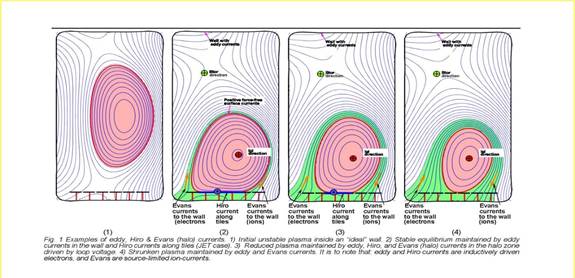
Instabilitățile plasmei ce ating peretele tokamak (Wall Touching Kink Mode – WTKM) sunt frecvent excitate în timpul Evenimentelor de Deplasare Verticală ale plasmei (Vertical Displacement Events – VDEs) și duc la forțe laterale mari asupra camerei de reacție, care sunt greu de gestionat în instalațiile tokamak mari. Drept bază pentru modelarea perturbațiilor plasmei, am luat în considerare înțelegerea modului în care curenții circulă spre suprafețele expuse plasmei în timpul perturbațiilor plasmei. Am realizat că contactul galvanic între plasmă și perete este critic în cazul perturbțiilor și că reproducerea structurii 3D a peretelui este importantă. Astfel, am dezvoltat un model de perete care acoperă atât curenții turbulenți, excitați inductiv, cât și curenții sursă/absorție datorită împărțirii curentului între plasma și perete. Pentru a obține distribuția în spațiu și timp a curenților de suprafață, am dezvoltat o formulare slabă (formulare variațională) și am minimizat funcționalele de energie corespunzătoare într-o abordare cu Elemente Finite. Am realizat că principalul factor în interacțiunile plasmei cu peretele camerei tokamak sunt curenții care circulă între plasmă și perete. Ca exemplu de distribuire a curenților între plasmă și perete în VDE, am luat în considerare: (a) curenții de suprafață ca fiind curenții de la limita plasmei generați de instabilități MHD cu graniță liberă; (b) curenții de Eddy (turbionari) în perete, excitați de câmpul magnetic perturbat, care sunt ecranați de curenții de suprafață ai plasmei; (c) curenții Hiro ca o componentă negativă a curenților de suprafață împărțiți între plasmă și peretele camerei de reacție tokamak (opuse curentului plasmei I_pl); (d) curentul Evans ca o componentă pozitivă a curenților de suprafață potențial împărțiți între plasmă și perete (în aceeași direcție cu I_pl); (e) curenții halo ca curenți difuzi, pozitivi orientați către suprafața camerei de reacție din afara ultimei suprafețe magnetice închise. In concluzie: am dezvoltat un model de WTKM (Wall-Touching-Kink-Mode) pentru a explica prezența vȃrfului de tensiune negativă din timpul disrupțiilor tokamak.
Pornind de la faptul că în tokamak-ul JET disruptiile au fost capabile să topeasca placile de beriliu aflate in contact cu plasma (astfel de daune similare ale pereților vor trebui a fi evaluate si in ITER) in acest proiect am luat in considerare două efecte importante ale disrupțiilor, atat pentru disruptiile atenuate, cat si pentru cele neatenuate din JET si ITER: (a) excitarea deplasarii verticale in timpul caderii curentului (de exemplu, scaderea anormală a curentului din plasma) si (b) efectul potential al depunerii energetice pe placile din camera de reactie in timpul disruptiilor legate de zona de contact a suprafetelor orientate spre plasma. Au fost determinat: – geometria zonei de contact precum și depunerea energetica pe marginile placilor de protectie din ITER, – limitarile ratei de scădere a curentului (cunoscând geometria structurii vasului si caracteristicile sistemelor de stabilizare prin feedback). Pentru simulari, am luat in considerare modelul TMHD (Tokamak MHD) cu grile adaptive aliniate cu liniile de câmp magnetic ergodic 3D, si am considerat coordonatele magnetice de referinta (Reference Magnetic Coordinates – RMC).
Marea majoritate a semnalelor generate de diagnostica tokamak sunt sub forma de serii temporale. Prin urmare, gestionarea datelor indexate in timp este o sarcina majora, care trebuie abordata zilnic atat de catre experimentatori, cat si de către analisti. Descompunerea unei serii temporale in termeni de componente sezoniere, tendinte, puncte de schimbare si zgomot este, prin urmare, o activitate cruciala, in sine si ca un pas preliminar pentru investigatii ulterioare. In lucrarea de fata, abordarea bayesiană de ansamblu pentru descompunerea modelului seriilor temporale, dezvoltata inițial pentru teledetectie, este aplicata diverselor masuratori globale disponibile in mod obisnuit in dispozitivele tokamak. Printre avantajele competitive ale metodologiei, deosebit de relevante sunt viziunea sa holistica asupra datelor si independenta fata de detaliile algoritmilor si modelelor statistice. Potentialul tehnicii, implementata prin codul BEAST, a fost evaluat atat cu semnale sintetice, cat si cu date experimentale. Abordarea se dovedeste a fi foarte fiabila în modelarea tendintelor si determinarea localizarii in timp ale schimbarilor bruste chiar si ale componentelor puternic oscilatorii, cum ar fi instabilitatile de tip ELM si sawtooth. Implementarea pentru evaluarea drift-urilor mici confirmă lipsa stationaritatii în descarcarile de inalta performanta ale tokamak-urilor. Dificultatile de modelare a detaliilor ELM si sawtooth indică necesitatea îmbunatatirii metodei pentru a trata componentele sezoniere cu continut armonic complex si/sau frecventa variabila. Cu toate acestea, rutinele disponibile sunt deja foarte eficiente in determinarea schimbarilor in timp in regimurile ELM si ar putea fi rafinate pentru implementare în timp real.
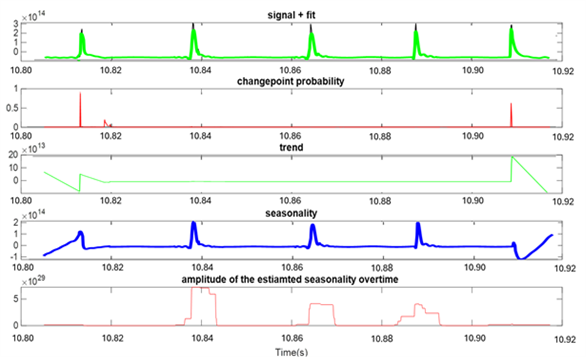
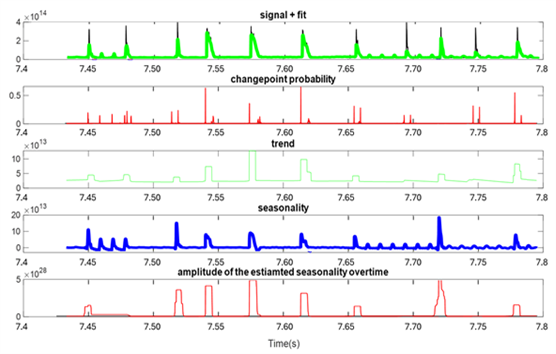
Descompunerea Bayesian a semnalului Be pentru descarcarea JET #94871, pentru caracterizarea instabilitatilor de tip ELM.
Abordarea bayesiană pe acre am dezvoltat-o pentru descompunerea seriilor temporale permite determinarea precisa și robusta a componentelor, gradientilor, a schimbarilor bruste si a zgomotului din datele furnizate de sistemele de diagnostica a plasmei, ceea ce este important in sine si ca un pas preliminar pentru tipuri mai avansate de studii. Dezvoltarea viitoare a unei metodologii automate si general acceptate pentru a indeplini aceasta sarcina ar fi foarte benefica pentru intreaga comunitate. Aceasta abordare reprezinta o linie suplimentară importanta de cercetare, pregatind dezvoltarea de instrumente utilizabile in feedback. In cazul descarcarilor relevante pentru sisteme tokamak indreptate spre producerea de energie, orice mica abatere de la punctul operațional ales ar trebui detectata cat mai curand posibil pentru a intreprinde actiunile de remediere necesare si a recupera performantele necesare ale plasmei.
.
Publicatii
Articole
- Gelfusa, M., Craciunescu, T., Rossi, R., Murari, A., On the potential and limitations of Bayesian ensemble algorithms for the decomposition of time series generated by tokamak diagnostics
(2025) Fusion Engineering and Design, 220, art. no. 115318 DOI: 10.1016/j.fusengdes.2025.115318 - Min Xu, Didier Mazon, Matteo Barbarino, Wolfgang Biel, R M Churchill, Rainer Fischer, Keisuke Fujii, Palak Jain, Andrea Murari, Simon D Pinches, Pablo Rodriguez-Fernandez, Joshua A Stillerman, Jesus Vega, Geert Verdoolaege, Masayuki Yokoyama, Paulo Abreu, Sajidah Akhter Bint Ahmed, Jerome Alhage, Feda ALMUHISEN, Michael George Bergmann, Diego Pereira Botelho, Leonardo Caputo, Stefano Carli, Rodrigo Castro, Teddy Craciunescu, Farah Deeba, Francisco Esquembre, Giil Kwon, Yu Gu, Joseph Hall, Jonathan Hollocombe, Xianli Huang, Axel Jardin, Rogerio Cabete de Jesus Jorge, Yang Li, Y Liu, Simon Mcintosh, Emmanuele Peluso, Riccardo Rossi, Mariano Ruiz, Jeffrey De Rycke, Mireille Schneider, Marco Sertoli, Aleix Puig Sitjes, Dirk Stieglitz, Yi Tan, Henri Weisen, Hao Wu, Ivan Wyss and Linge Zang, Summary of the 5th IAEA Technical Meeting on Fusion Data Processing, Validation and Analysis (FDPVA), Nuclear Fusion, accepted DOI 10.1088/1741-4326/ae048d
Participari la conferinte internationale
R. Rossi M. Gelfusa, T. Craciunescu, J. Vega, A. Murari, Avoiding the Collapse of the Tokamak Configuration: an AI based Control Strategy for Reactor Grade Devices, International Conference on Diagnostics For Fusion Reactors: the Burning Plasma Era (ICFRD2025), 1–5 Sept 2025 Varenna, Villa Monastero (oral)
Sergei N. Gerasimov, Leonid E. Zakharov, Calin V. Atanasiu, “Toroidal asymmetry in current spike in JET disruptions”, International conference: “Contributions to Joint Runaway Electron Modelling (REM) and WPTE (Work Package Tokamak Exploitation) RT03 Analysis meeting 2-6 June 2025, EPFL Lausanne, Switzerland”.